


1. Introduction
Taipei’s Wen-Luo-Ting, is an area surrounded by Wenzhou street, Roosevelt Road, Tingzhou Road and Xinsheng South Road, and it is a community with numerous bookstores, literary events, and historical underground architecture. With the characteristics of second-hand book stalls in Guling Street in the 1960s and after relocations over time, it consisted of the political idea of anti-intellectualism and identity in Taiwan, making it a compelling case for cultural geographical analysis.
To start with the cultural characteristics of Wen-Luo-Ting, the community is formed by traces including ideological literature, underground spaces with historical political background, and cultural activities successively resisting against dominant power. With the intersection of the university-surrounded location, changing importance of second-hand books, and historical state repression under Japanese colonial rule, Martial Law, White Terror, the community continuously affected by the cultural values of freedom and marginal knowledge.
Based on cultural geography and Foucault’s theory of power, this paper will analyse how dominating and resisting political and social powers continually create, erase, or change traces, and so reshaping the community’s meaning from covert revelation centre to modern cultural innovation site.
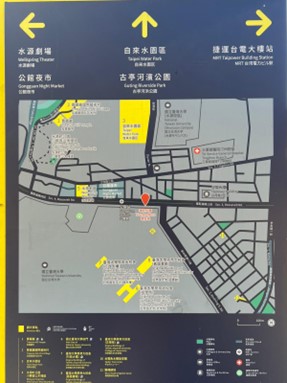
Map photo taken by groupmate at Wen-Luo-Ting
2. Cultural Geographical Perspective in Use
Investigation on a place in a cultural geographical perspective is not only describing the view, but also seeking the path of development behind all the appearing elements. A place is constituted by an imbroglio of traces, which are marks, residues or remnants made by the intersections of culture and context (Anderson J., 2010).
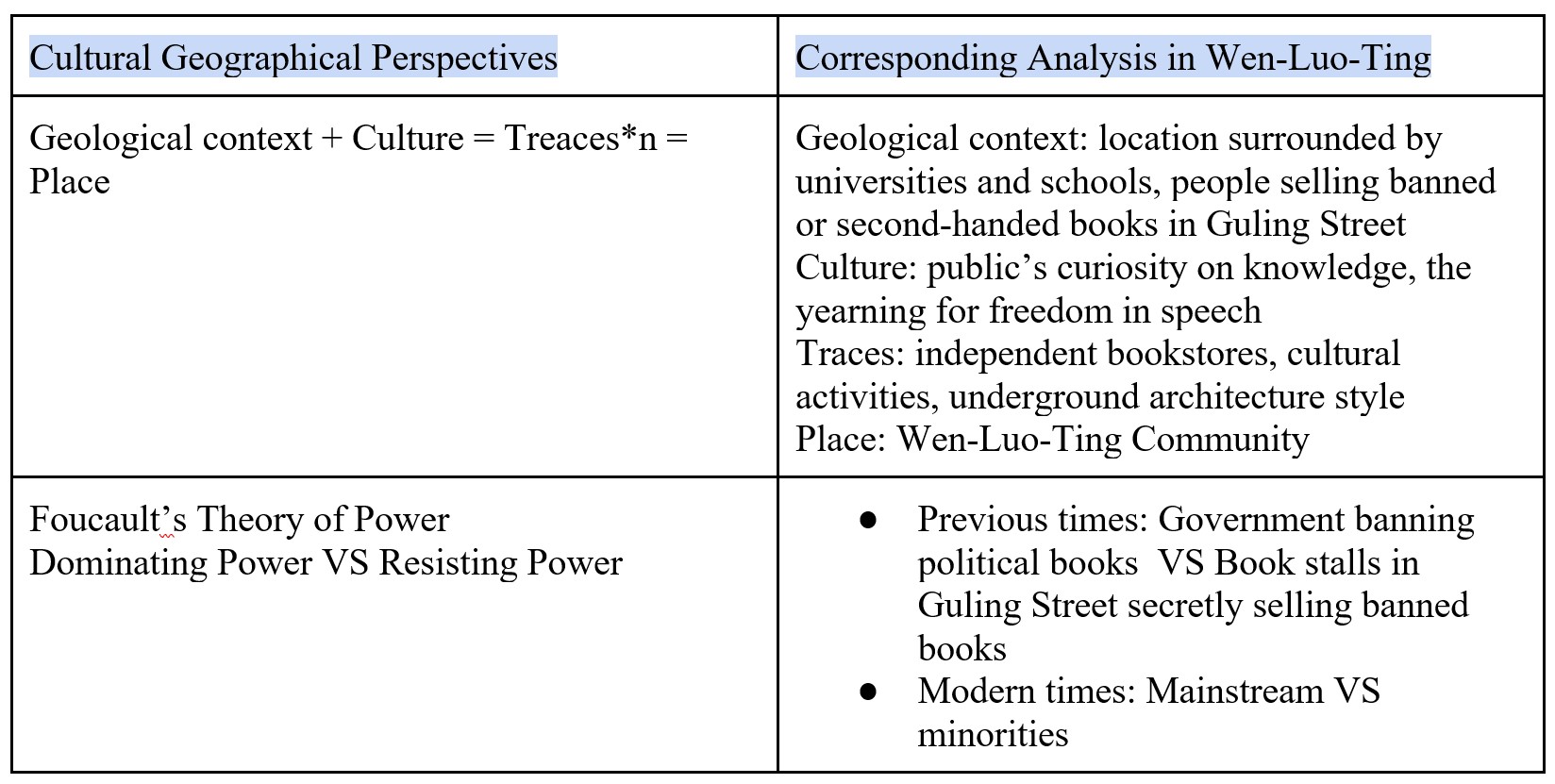
Wen-Luo-Ting is geographically located in the centre of the school-town atmosphere, acting as a diverse cultural community flourishing by different independent bookstores and literature-related activities. Its precursor as an area concentrated with second-handed book stalls in Guling Street paved the road for its transformation to the Wen-Luo-Ting community. Apart from traces including independent bookstores in different themes and various cultural activities, underground architecture style representing the freedom of speech also shape the unique place and attract many visitors.
While existing traces keep changing under the influence of power proposed by Foucault (Christensen, 2024), the place is regarded as a dynamic entity. During the confrontation between dominating power and resisting power, traces are either disappeared or created to modify the significance and role played by the place, thus forming a complex culturally-distinctive enclave.
In the study, we can see the role of the Wen-Luo-Ting community evolving from a place of cultural enlightenment to a popular landscape where cultural innovation and new wave ideas are provoked by resisting dominating power. From literati’s resisting power on secretly selling banned political books against the government’s dominating power on restricting the political views received by the public during the Martial Law Period to the minority groups’ resisting power on protecting their rights against the mainstream’s dominating power on defining the ‘normal’ and ‘abnormal’ in the modern days, the place has precisely showed the struggle of knowledge and rights between the two parties. Throughout the struggles, the bookstores representing each party present a phenomenon of creating and constructing new communities, new culture and new identity, thus enriching the significance behind the Wen-Luo-Ting community.
3. Empirical Analysis
Intersection of Culture and Context by an Imbroglio of Traces
The formation of Wen-Luo-Ting can be traced back to the 1960s. In the 1960s, Guling Street was famous for street second-hand stalls all over the street. At that time, due to the rise of stalls, local police officers would like them to make a change from placing all the goods on land to placing the goods on shelves next to the walls for the sake of road safety. Till 1974, to address the traffic issues at the level crossing of the North-South Railway Line, the Guanghua Bridge was constructed, with an integrated market beneath it. Vendors from Guling Street were relocated to operate in Guanghua Mall, with the basement level primarily housing used bookstores. However, Guanghua Mall was removed afterwards, some second-generation bookstore owners relocated their shops near universities. This is the predecessor of Wen-Luo-Ting. It shows a natural transformation of the sense of place according to time. Wherever the second-hand book vendors relocate, that will become the book hub, attracting book lovers or treasure diggers to gather there, demonstrating the spatial practice of a cultural landscape. Besides, it is an event-controlled space, the vendors and book stores are significant to the mentioned spaces, the core value of the geographical meanings is based on people’s activities and footprint, constituting a socially produced space. With different roles, people will view them or these districts with different views, the government saw them as the ones causing chaos, while the general public saw them as a treasure box, reflecting a process of place-making and the politics of space.
Talking about Wen-Luo-Ting nowadays, it has a high density of book stores and cafes, and also a university hub (Hsu, 2007). Through time, the image of these book stores have a huge difference, from a place where poor people love to buy books from, to a highbrows’ hub due to the relocation and people’s perspective on second-hand books. The most famous bookstore there is Tangshan Bookstore, also known as the “underground book kingdom”, selling books in the humanities and social sciences. Back the June 12 Restriction (六一二大限) in 1992, when foreign copyrights became legally protected in Taiwan, they also published many unauthorised translations of scholarly works in these fields. It was once a hub for banned books, a key platform for student works, including both written and audiovisual pieces, that were not viable for mass production (Multitude.asia, 2017). Therefore, to hide from the government’s checking, they chose to locate the store underground. Its underground architectural style has not changed till today, after the recreation of the district by the government. It is a reflection of the values of the Taiwanese government, which would like to emphasise freedom of speech and would like to alert people to the difficult time by keeping its original design, a form of counter-geography. This explores how power produces knowledge and normalizes standards, and how resistance is inherent to power, manifesting itself through the struggle over discursive power, embodying the tension between space and power.
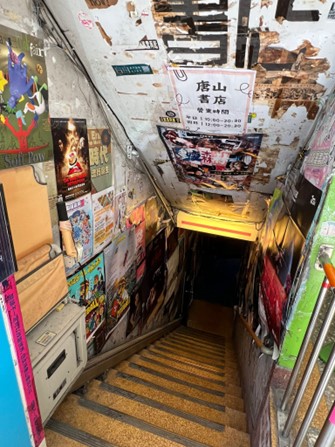
Photo of 唐山書店 taken by groupmate at Wen-Luo-Ting
Representative of Resisting Power Throughout the Time
During the Japanese rule from 1895, Taiwan was politically and socially suppressed by Japan. As the goal was to turn Taiwan into an industrial hub for supplying various resources to Japan (Xiu, 2018), multiple attempts were made to forcefully adapt Taiwan to the "Japanese style", thus the heavy suppression of opposing ideas. This included the Taipani Incident in 1915 which massacred hundreds of Taiwanese who attempted to rebel (Chen, 2012); and the publication of the Chian-keisatsu-hou (1900) which seriously infringed the freedom of assembly and freedom of speech of the locals. Due to the heavy suppression, the urge for oppression has heightened.
Afterwards, the Kuomintang retreated to Taiwan and since then, Taiwan has entered a period of white terror under the authoritarian rule of the Kuomintang (Chen, 2012). Meanwhile, the National Taiwan University has been a hub for elites and intellectuals, creating an academic neighbourhood around the university. Therefore, the Wan-Luo-Ting area in the neighbourhood has become essentially a safe haven for these intellectuals to gather. Bookstores in the community have also started to sell books that are censored, or those which are considered avant-garde around the community of political elites.
The Wan-Luo-Ting area has become a symbol of political rebellion and free-thought since and therefore has been a place filled with independent bookstores with their respective ideologies. These ideologies often differ from the mainstream, for instance the Feminist bookstore Fembooks, Left-wing Ton San Bookstore and Christian Campus Books (Lam, 2007). These bookstores have maintained to be the symbols of free-thought since the formation of the district.
4. ConclusionThis study reveals Wen-Luo-Ting as a complex cultural community which identifies emerging geological factors ,and cultural resistance with the unrelenting pursuit of forbidden knowledge and marginalised voices. The concept of place as an “imbroglio of traces” (Creswell, 2006) and Foucault’s theory illuminate how traces—underground bookstores, banned-book legacies, feminist and left-wing shelves—are actively showing that resisting power is everlastingly challenging the dominating power, from Martial Law-era secret sales to contemporary minority struggles.
This paper shows the social construction process of the modern urban cultural landmark. To safeguard the vitality of such a unique community, the government should protect independent bookstores through providing financial support or strengthening the heritage status, resisting modern gentrification that might affect counter-hegemonic traces. Besides, it is essential to actively support minority-run spaces, ensuring the district remains a living laboratory of freedom. Only by preserving its traces can Wen-Luo-Ting continue to produce new identities and knowledge for Taiwan’s future.
Anderson, J. (2010). Understanding Cultural Geography: Places and Traces. New York and Oxon: Routledge.
Christensen, G. (2024). Three concepts of power: Foucault, Bourdieu, and Habermas. Three Concepts of Power: Foucault, Bourdieu, and Habermas, 16(2), 182–195. https://doi.org/10.1177/17577438231187129
Creswell, T. (2006).《地方:記憶、想像與認同》.(王志弘、徐苔玲譯). 台北:群學.
陳信安. 2012.《以文化觀光思維建構「1915 年焦吧哖事件」文化路徑紀念場域之研究 》. 行政院國家科學委員會專題研究計劃.
陳銘城,2012,秋蟬的悲鳴:白色恐怖受難文集,新北市,國家人權博物館籌備處.
大蔵省印刷局(官報). 1900. 法律治安警察法. 日本マイクロ写真出版, 東京. 10.11501/2948297
林欣靜. (2007, September). 溫羅汀獨立書店風景. 台灣光華雜誌 Taiwan Panorama | 國際化,雙語編排,文化整合,全球華人的雜誌. https://www.taiwan-panorama.com/Articles/Details?Guid=ef5801d7-e6ce-4291-b7da-e7c1a82bcb41&CatId=8&postname=%E6%BA%AB%E7%BE%85%E6%B1%80%E7%8D%A8%E7%AB%8B%E6%9B%B8%E5%BA%97%E9%A2%A8%E6%99%AF&srsltid=AfmBOorp0XW1DrPyHFpDlgND8atixtl5tHvwZgDyVh_NuMHSqBcTB_FV
Multitude.asia. (2017, September 22). 如果我盜版到一百種的時候…| 唐山書店陳隆昊訪談 (二) [Video].
王 泰升. 2004. 植民地下台湾の弾圧と抵抗 日本植民地統治と台湾人の政治的抵抗文化. 札幌学院, 訳者 鈴木敬夫.
Xiu, C. (2018, April 20). A Multi-Perspective Analysis of the Japanese Factor in the Taiwan Issue. Interpret: China. https://interpret.csis.org/translations/a-multi-perspective-analysis-of-the-japanese-factor-in-the-taiwan-issue/
徐詩雲. (2007). 當代文化階層的地方認同競逐:「公館�溫羅汀」〔碩士論文,國立臺灣大學〕. 華藝線上圖書館. https://doi.org/10.6342/NTU.2007.03053