1. Introduction
This project examines the
interaction between the theming of place in Dali Old Town and the ethnic identity
of the Bai people. Through tourism-oriented renovations, its themed landscapes
(such as restored Bai architecture, folk performances, and cultural products)
are reshaping the local space and ethnic identity, leaving tangible cultural
traces(the shift of traditional
customs from ‘daily practice’ to ‘tourist spectacle’). These traces record both the long-standing
integration of modern and Bai cultures and the contemporary negotiation between
tourism capital and local traditions (1,2). This phenomenon warrants close
attention, as it represents a powerful global process: local cultures are being
repackaged into marketable landscapes, fundamentally reshaping ethnic
identities. Geographically, Dali’s location as a pivot on the Sino-Tibetan
route, its tourism-dependent economy, and Yunnan’s “14th Five-Year” cultural
tourism policies drive this theming. The project draws on Urry’s “tourist gaze”
and Relph’s “place identity” concept to analyze the interconnections between
the phenomenon, geographical context, and culture.
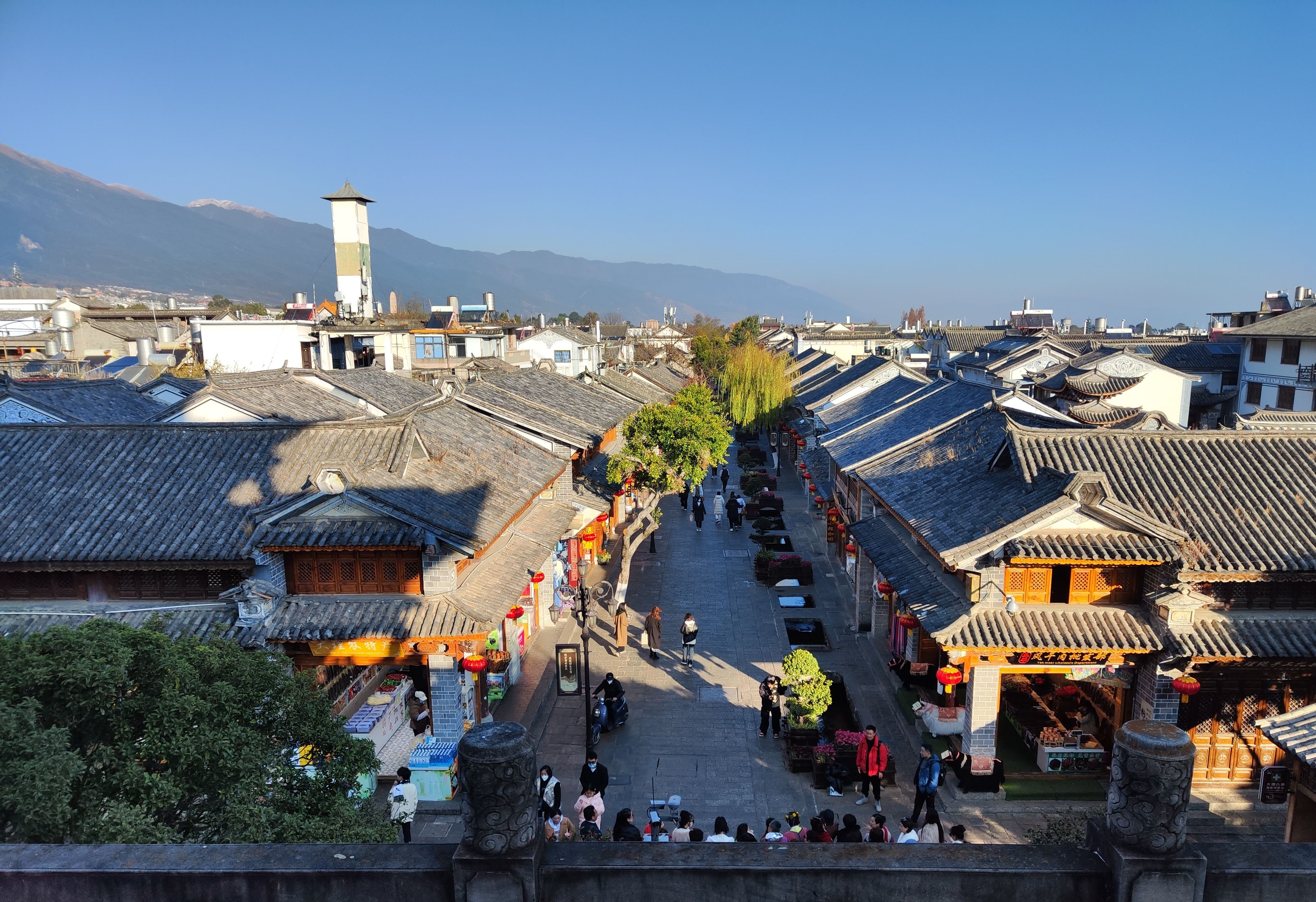
2. Cultural Geographical Perspective in Use
In this work, we adopt a cultural geographical approach
to decipher the way theming of place in Dali Old Town changes the Bai ethnic
identity with the help of tourism development. The cultural geography
perspective emphasizes that landscapes are not only physical but are the
results of meanings, performances, and power.. The perspective explains why the
"Bai cultural landscape" of Dali is not just handed down but is also
reconstructed.
The
idea of place-making will be introduced, as the old town has been intentionally
turned into a visible "Bai space" by the means of the restored
architecture, the streets, and the staged cultural activities so that the image
of Bai that is mostly given to the tourists is the one that has been actively
produced but not preserved. This points to cultural commodification to which
the traditional practices like tie-dyeing, Jiama painting, clay sculpture, and
even wedding rituals are converted into commercial products. Bai cultural
symbols are turning to be the major economic resources, thus causing the
discord of authenticity and tourist expectations, as pointed out by Yang, Xue,
and Song (2021). Urry’s concept of the tourist gaze clarifies these changes, tourists
come with the preconceptions of what a minority culture is, and both the
government and tourism businesses reshape the place to meet these expectations.
This mechanism is the reason why customs are being simplified into short,
visually appealing shows and traditional courtyard houses become boutique
houses.
Moreover,
Relph’s point of view about place identity being a factor in understanding the
employment of Bai symbols in the public space, either in architecture or
performances, constructing a collective feeling of “Bai-ness” that impacts not
only the tourists but also the local residents who have to figure out their
cultural belonging in a themed environment which reflects commercial logic more
and more. A recent research conducted by Bai and Weng (2023) also reveals that
tourism-driven commodification is not only reordering local cultural layers but
also pushing the visually attractive elements to everyday practices, which is
similar to what is happening in Dali. Those combined give an analytical
framework where Dali Old Town is the result of the interaction of government
policies, tourism capital, and preferences, turning the town into a cultural
trace that indicates both the persistence of Bai identity and the pressures of
commercialization, thus having a direct impact on the changes talked about in
the empirical section.
3. Empirical Analysis
The
geographical diversity of Dali Ancient City allows four core
elements—mountains, lakes, plains (basins), and the ancient city itself—to
converge within a compact area. Centered on the ancient city, three distinctly
different terrains can be witnessed within a ten-kilometer radius: mountain
ranges, lakes, and plains (basins). The geographical diversity of Dali Ancient
City concentrates four core elements within a compact area: mountains, lakes,
plains (basins), and the ancient city itself. Dali's unique geographical
environment is inextricably linked to Bai culture. For instance, the
preservation of intangible cultural heritage, including tie-dyeing, resist
dyeing, and clay sculpture techniques—relies on the indigo plants cultivated in
the plains and basins; meanwhile, clay sculptures utilize local soil sourced
from lakeshores (4). Combined with its unique cultural background, it provides
an ideal venue for showcasing Bai ethnic culture through tourism. The Dali Old
Town as a historical and cultural tourism destination provides a tangible space
for showcasing and monetizing Bai ethnic culture, fulfilling the practical
needs of cultural preservation. (4) The local culture is selected and
rearranged, and traditional cultural elements are simplified, condensed, and
dramatized to meet market demands (tourists' time, aesthetics, and curiosity),
thus reshaping the ways in which culture is represented. In order to facilitate
economic development, the government is dedicated to developing Dali Old Town
into a renowned tourist attraction which is rich in history and culture. The
government has provided a new platform and impetus for the inheritance of Bai
ethnic intangible cultural heritage such as tie-dying, Jiama, and clay
sculpture (2023). By the combination of intangible cultural heritage and
tourism, these traditional crafts are no longer only exhibiting in museums, but
have been transformed into cultural and tourism products that can be
experienced and purchased by customers as well as have competitiveness in the
market (2024). Under the development of tourism, the Bai ethnic group can
understand the value of their own culture. Therefore, it can enhance their
sense of pride in culture and sense of identity. As a result, integrating the
Bai ethnic culture into tourism promotion can increase their cultural influence
(2024). On the other hand, driven by commercial interests, some traditional
cultural elements are simplified and repackaged to cater to tourists’
preferences. One of the examples is the performance of traditional weddings and
festival celebrations for the culture of the Bai ethnic group (2017).
Originally, the traditional Bai wedding is a complicated social ritual
involving the marriage of two families, strict procedures, specific songs, and
symbolic gestures such as “pinching the bride” as a blessing (2017). This is an
introverted and culturally significant event. However, in order to cater
tourists’ curiosity, these weddings have been adapted into daily scheduled
stage performances. The duration has been condensed to 15-30 minutes and
performances only retain the most visual elements such as gorgeous clothes, and
lively song and dance while removing all introspective aspects involving
genuine emotions and community networks (2017). Tourists become
"spectators," and the ceremony transforms from a social institution
into a cultural show, almost completely losing its original social function and
sanctity. As a result, some cultures of the Bai ethnic group are largely
presented to support the tourism industry. Local people do not feel proud of
their culture. Instead, they unhealthily display their characteristics in
pursuit of commercial gain.
4. Conclusion
“Eight Vertical
and Eight Horizontal” High-Speed Rail development in 2016 provide an accessible
route for tourism in Yunnan province. The completion of the Shanghai-Kunming
and the Nanning–Kunming high-speed railway in December 2016, slashed travel
time from Kunming to Dali from over six hours to roughly two, instantly
transforming Dali Old Town from a relatively secluded Bai cultural enclave into
one of China’s most accessible mass-tourism destinations.
The overtourism of Dali Old Town stems from the integration of its unique
geographical landscape with Bai ethnic culture: the enclosed terrain not only
fosters the romantic Bai culture but also provides a natural stage for cultural
display. Through long-term place-making, tie-dying, Jiama, and clay sculpture
and other elements, this town has been endowed with a strong sense of belonging
and identity. Since the 1990s, however, under heritage conservation policies,
development of high-speed railway, and the drive of globalized consumption,
Dali old town has undergone rapid modification. The government and capital,
responding to the “tourist gaze,” selectively simplify and stage otherwise
complex local culture: traditional courtyards are converted into boutique
guesthouses, weddings become paid performances, and historic compounds have
been commercialized. In 2025, Dali Bai Autonomous Prefecture received over 5.21
million tourist visits. (Yunnan Provincial People's Government, 2025) Thus, the
old town now exhibits a double-edged sword: on the surface, a romantic Bai
ancient town; in reality, a highly themed consumption space co-scripted by
government, capital, and tourists. It is both a site of resilient Bai cultural
survival and a microcosm of the tensions in China’s ethnic minority regions
amid modernization—between tradition and commodity, authenticity and
performance, local and global—revealing the profound contradiction between
cultural heritage preservation and tourism development.
References
Bai, L., & Weng, S. (2023). New perspective of cultural sustainability:
Exploring tourism commodification and cultural layers. Sustainability,
15(13), 9880. https://doi.org/10.3390/su15139880
Chen, S. Y. (2017). A Summary of
Japanese Scholars’ Research on Yunnan Minority Cultural Studies in the 21st
Century. 现代人类学, 5(3): 33-39. https://doi.org/10.12677/ma.2017.53005
Yang, H.,
Xue, M., & Song, H. (2021). Between authenticity and commodification:
Valorization of ethnic Bai language and culture in China. International
Journal of English Linguistics, 12(5), 74–84.
https://doi.org/10.5539/ijel.v12n5p74
Yunnan Provincial People's Government.(2025). 大理州接待游客逾521万人次. Retrieved
November 19, 2025, from https://www.yn.gov.cn/ywdt/zsdt/202510/t20251010_318537.html
丁怡全, &严勇.
(2024). 瞭望 | 大理:文旅产业圈圈突破. 新华网. http://www.xinhuanet.com/ci/20241112/e7894c6e37d54981aac971d8f919fc6d/c.html
大理日报新闻网.
(2023). 国家历史文化名城—大理. https://www.dalidaily.com/content/2023-03/20/content_44948.html